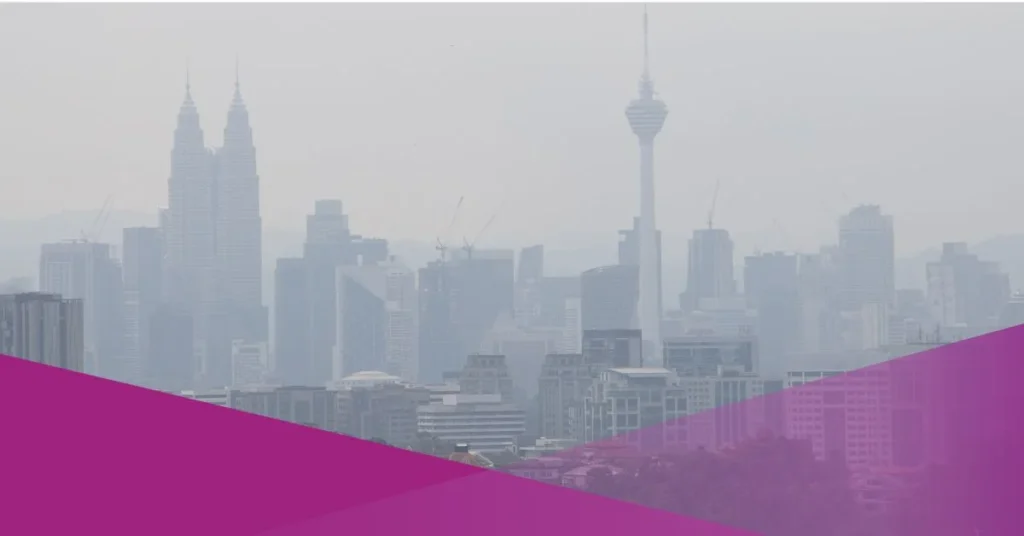
Singapore has secured pledges of full cooperation from 10 companies potentially linked to haze-causing fires in Indonesia, following a rare meeting between senior business executives and three government ministers on Wednesday, 28 October.
Deputy Prime Minister Gan Kim Yong, Senior Minister K Shanmugam and Minister for Sustainability and the Environment Grace Fu met the companies’ representatives to outline the government’s expectations and discuss plans to strengthen Singapore’s response to transboundary haze pollution.
The meeting came after the National Environment Agency (NEA) issued notices to the 10 Singapore-based companies under the Transboundary Haze Pollution Act (THPA) on 23 October. The notices require them to provide information about their links to companies in Indonesia that may have contributed to the fires.
The haze has affected Singapore’s air quality, which reached very unhealthy levels earlier in October, raising concerns about the health and environmental consequences of fires in the region.
Shanmugam said the government would pursue all available legal and regulatory avenues to establish responsibility for the fires.
“Haze is caused by fires,” he told the company representatives.
“Fires are caused by irresponsible business practices. It is not a natural phenomenon.”
Singapore Plans Tougher Haze Laws and Independent Assessments
During the meeting, the government outlined plans to strengthen the Transboundary Haze Pollution Act, including proposed amendments that would make it an offence for companies to refuse independent assessments or fail to cooperate fully with investigators.
Fu said the government intended to introduce the amendments at the next parliamentary sitting.
“I will be making amendments to the Transboundary Haze Pollution Act at the next parliament sitting to give this framework the force of law. Companies that do not comply will be committing an offence. We will exercise our powers to protect the health of Singaporeans,” she told reporters after the meeting.
Under the proposed framework, companies may be required to appoint independent assessors to examine their operations, corporate relationships and supply chains. The assessors will be selected from a panel identified by the government, with the companies expected to bear the costs.
The assessments are intended to establish whether the companies have contributed to the fires, either directly or through their business relationships.
Shanmugam stressed that the investigation was not intended to assign blame before the facts had been established.
“The intention of this exercise is not to find scapegoats, nor is it to fix blame for public or political reasons,” he said.
He added that companies with no involvement in the fires and clean supply chains would be able to demonstrate this through the assessments.
“Where there are concerns about a company’s involvement, whether directly or through its corporate relationships or supply chains, we will examine the facts carefully,” he said.
“We cannot allow corporate structures or third-party arrangements to stand in our way of establishing the facts.”
Companies Pledge Cooperation as Singapore Seeks Accountability
The 10 companies represented at the meeting included Bumitama Agri, First Resources, Golden Agri-Resources, Indofood Agri Resources, Kencana Agri, TSH Resources and Wilmar International. Sinar Mas Group was also represented, alongside Asia Pulp & Paper Company and Asia Pulp & Paper Company (China).
All 10 companies reportedly agreed to cooperate fully with the investigations.
Shanmugam said Singapore would not assume that the companies were guilty or that they were the only businesses involved in the fires.
“I don’t want to give the impression that these companies are guilty, nor do I want to give the impression that these are the only companies that are doing this,” he said.
He added that the government had also issued notices to other companies without a presence in Singapore.
The government has appointed Senior Counsel Davinder Singh as an adviser and coordinator for the assessment process. The assessors may also work with third-party specialists, including remote-sensing and geospatial analysts, to examine satellite hotspot data.
Singapore’s efforts come as the country seeks to address the recurring problem of transboundary haze pollution, which has affected public health and air quality across Southeast Asia.
Fu said the government remained determined to act, even as haze conditions improved.
“The government takes this seriously, and we are determined to act,” she said. “Even as the haze condition improves, we will not relent.”