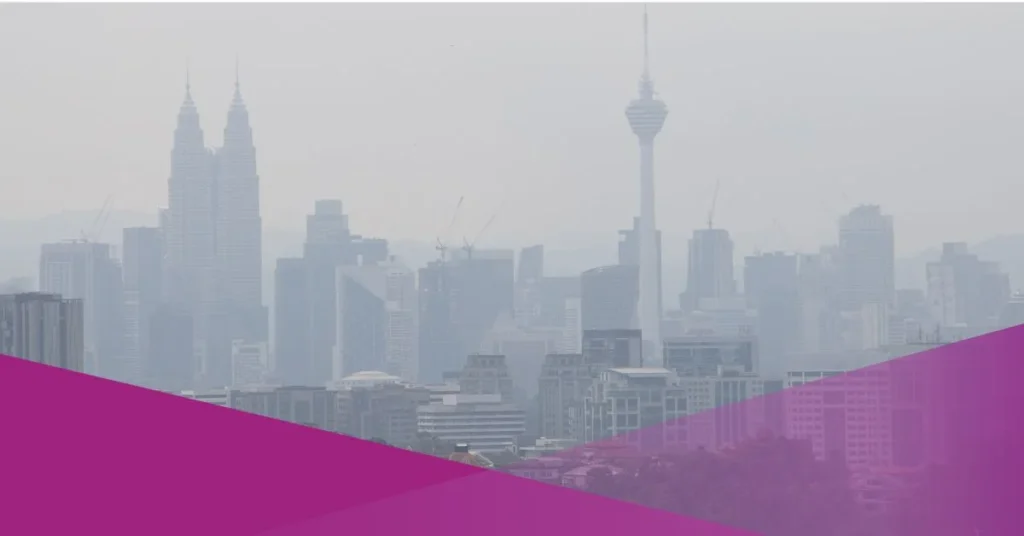
Singapore’s air quality deteriorated on 9 October, with the central region recording a Pollutant Standards Index (PSI) of 186. Residents are advised to limit strenuous outdoor activity as smoke haze continues to drift across the island from parts of Indonesia.
Singapore’s haze intensified on Friday, 9 October, with air quality reaching its worst level of the year so far in the central region. The 24-hour Pollutant Standards Index (PSI) climbed to 186 at 2pm, while the hourly PM2.5 reading reached 131 micrograms per cubic metre, placing it in the elevated pollution band.
The central region’s PSI had already reached 170 by 9am, surpassing the previous 2026 high of 167 recorded on 29 September. The reading continued to rise throughout the morning, reflecting a broader deterioration in air quality across Singapore.
The National Environment Agency (NEA) has advised residents to reduce prolonged or strenuous outdoor physical activity when PSI readings fall within the unhealthy range.
Singapore Haze Update: Air Quality Across the Island
At 2pm on 9 October, all five regions of Singapore recorded PSI readings within the unhealthy range, which is defined as a score between 101 and 200.
| Region | 24-hour PSI at 2pm |
| Central | 186 |
| West | 177 |
| South | 164 |
| East | 159 |
| North | 130 |
Air quality across Singapore remained largely unhealthy throughout 8 and 9 October. Some regions briefly returned to the moderate range between 6pm on 8 October and 1am on 9 October, before readings rose back into the unhealthy category from 2am.
The 24-hour PSI is calculated using a rolling average of six key air pollutants. It provides an indication of overall air quality and helps residents assess the potential health implications of outdoor activities.
PM2.5 Levels Remain Elevated Across Singapore
Alongside the rising PSI, hourly PM2.5 readings indicated elevated concentrations of fine particulate matter across the island.
At 2pm on 9 October, the readings were:
| Region | Hourly PM2.5 reading |
| West | 144 µg/m³ |
| Central | 131 µg/m³ |
| South | 120 µg/m³ |
| East | 116 µg/m³ |
| North | 92 µg/m³ |
PM2.5 refers to fine particles small enough to penetrate deep into the lungs. The NEA uses hourly PM2.5 readings to assess immediate air quality and guide decisions about outdoor activities.
Readings between 56 and 150 micrograms per cubic metre are classified as elevated, while readings between 151 and 250 fall within the high pollution band. The highest hourly PM2.5 reading recorded in Singapore so far in 2026 was 171 in the western region at 2am on 9 October.
Although hourly PM2.5 and 24-hour PSI measure air quality over different periods, both provide useful guidance when deciding whether to exercise, commute on foot or spend extended periods outdoors.
Why Is Singapore Experiencing Haze?
According to the NEA’s evening advisory on 8 October, moderate to dense smoke plumes from southern and central Sumatra, as well as West Kalimantan, were observed drifting towards Singapore.
Dry conditions were expected to continue in these neighbouring Indonesian territories, while prevailing south-easterly or southerly winds could carry more smoke towards the island.
The NEA had forecast that the 24-hour PSI would remain within the high-moderate to mid-unhealthy range. The subsequent rise in readings on 9 October highlighted the need for residents to follow official air quality updates rather than rely solely on the appearance of the sky.
How the Haze Can Affect Your Daily Activities
When the 24-hour PSI reaches the unhealthy range, healthy individuals should reduce prolonged or strenuous outdoor physical activity, according to the NEA’s haze advisory.
People who may be more vulnerable to the effects of air pollution include older adults, pregnant women, children and those living with chronic lung or heart conditions. These groups should take additional precautions and may need to avoid outdoor activity depending on the pollution level.
For residents planning to walk around the city, exercise outdoors or attend open-air events, checking the latest hourly PM2.5 reading can help inform decisions for the next hour. The 24-hour PSI forecast is more suitable for planning activities for the following day.
What to Do at Different PM2.5 Levels
The NEA’s guidance for immediate outdoor activities is based on four hourly PM2.5 bands.
| PM2.5 band | Reading | Recommended action |
| Normal | 0 to 55 µg/m³ | Continue with normal activities |
| Elevated | 56 to 150 µg/m³ | Reduce strenuous outdoor activity for the next hour |
| High | 151 to 250 µg/m³ | Avoid strenuous outdoor activity for the next hour |
| Very high | More than 250 µg/m³ | Minimise all outdoor activity for the next hour |
Vulnerable individuals should avoid strenuous activity outdoors when readings reach the elevated band or higher. At high or very high levels, they should take greater care and follow the NEA’s specific recommendations.
Planning Outdoor Activities Based on the 24-Hour PSI
For activities planned for the following day, the NEA categorises air quality into five levels: good, moderate, unhealthy, very unhealthy and hazardous.
| 24-hour PSI | Healthy individuals | Vulnerable individuals |
| Good, 0 to 50 | Normal activities | Normal activities |
| Moderate, 51 to 100 | Normal activities | Normal activities |
| Unhealthy, 101 to 200 | Reduce prolonged or strenuous outdoor physical exertion | Minimise prolonged or strenuous exertion. Those with chronic lung or heart disease should avoid prolonged or strenuous exertion |
| Very unhealthy, 201 to 300 | Avoid prolonged or strenuous outdoor physical exertion | Minimise outdoor activity. Those with chronic lung or heart disease should avoid outdoor activity |
| Hazardous, above 300 | Minimise outdoor activity | Avoid outdoor activity |
The NEA identifies older adults, pregnant women and children as vulnerable groups. People with chronic lung disease or heart disease should also pay close attention to the forecast and follow the more cautious recommendations applicable to their health category.
These recommendations are intended to help residents make practical decisions about exercise, commuting and other outdoor plans as conditions change.
Where to Check the Latest Singapore Haze Readings
Haze conditions can change throughout the day as wind direction and smoke movement shift. Residents should check official updates before planning outdoor activities, particularly when readings are already elevated.
For a detailed tracker of Singapore’s regional PSI readings and haze developments, refer to The Straits Times’ Singapore Haze 2026 tracker.
As air quality remains unhealthy across the island, residents should consider moving strenuous exercise indoors, limiting extended outdoor exposure and taking particular care of children, older adults and people with existing heart or lung conditions. Staying informed through official advisories remains the most reliable way to plan around the haze.